
What are the symptoms of newborn jaundice?
Jaundice usually appears first on the baby's face, then progresses downward to the chest, belly, and legs as bilirubin rises.
- Yellowish skin, visible when gently pressing the baby's forehead or nose in good light
- Yellow tint in the whites of the eyes (sclera)
- Yellow palms of the hands and soles of the feet in severe cases
- Baby unusually sleepy and hard to wake for feeds
- Pale clay-colored stools or dark yellow urine (newborn urine should be clear)
- Poor feeding or weak sucking reflex
Warning signs: go to hospital at once
These indicate dangerously high bilirubin (acute bilirubin encephalopathy) requiring emergency care.
- Jaundice appearing within the first 24 hours of birth
- Jaundice spreading down to the baby's belly, arms, or legs
- Extreme lethargy: baby cannot be woken to breastfeed
- High-pitched, irritable crying that cannot be soothed
- Baby arching back or neck backward (retrocollis/opisthotonos)
- Fever or seizures in the newborn
Call 108 or go to the nearest emergency department.
The 3 phases of newborn jaundice
Pathological jaundice
Any jaundice in the first day of life is abnormal and needs immediate blood tests for blood group incompatibility.
Physiological jaundice
Common as the immature liver processes red blood cells. Peaks around day 3–5, then typically fades.
Prolonged / Breast milk jaundice
Fades gradually over 2–3 weeks. Persistent jaundice after 14 days needs medical evaluation.
Which test shows newborn jaundice?
Rapid, precise diagnostic testing performed on site in our laboratory.
| Test | Best time | What it tells you |
|---|---|---|
| Total & Direct Serum Bilirubin (TSB) | Same visit | Accurately measures blood bilirubin to determine if phototherapy is needed |
| Blood Group & Rh Typing (Mother and Baby) | If jaundice appears early | Checks for ABO or Rh incompatibility |
| Complete Blood Count (CBC) & Reticulocyte count | If severe or rapid rise | Checks for ongoing red blood cell breakdown (haemolysis) |
How is newborn jaundice treated?
Treatment depends on the baby's age in hours, birth weight, and bilirubin level plotted on standard neonatal charts.
At Nareddy Care
- Full neonatal examination by Paediatrician-Neonatologist Dr. Bramhini Nareddy
- Same-visit serum bilirubin blood test in our laboratory
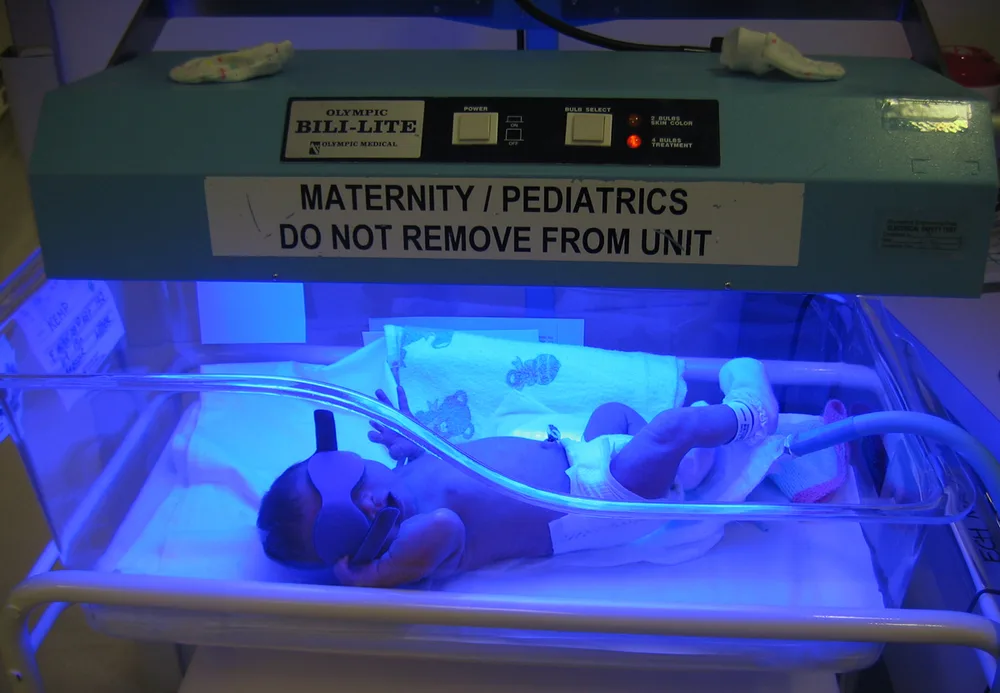
- Phototherapy treatment with calibrated blue-light units in our day-care unit
- Radiant baby warmer support to maintain temperature
- Breastfeeding and lactation coaching for adequate intake
Do at home
- Feed the baby frequently (8 to 12 times in 24 hours) to promote bilirubin elimination through stools
- Gently check skin color in natural daylight, pressing forehead and chest lightly
- Keep track of wet diapers (at least 6 wet diapers daily after day 4)
- Bring baby back for repeat bilirubin testing as recommended
Avoid
- Relying on direct sunlight at home, which cannot replace medical phototherapy and risks sunburn and hypothermia
- Giving plain water, glucose water, or herbal tonics to a newborn
- Waiting to see if deep yellow skin on the belly or legs goes away on its own
- Stopping breastfeeding unless specifically advised by your paediatrician
How to prevent newborn jaundice
Early and frequent breastfeeding initiated in the first hour of birth, ensuring good latch, and having the baby checked by a paediatrician around day 3–5 after hospital discharge.
Questions people ask
Is keeping my jaundiced baby in sunlight safe?
Morning sunlight has traditionally been used for very mild jaundice, but it is not sufficient for high bilirubin levels and risks sunburn. Medical phototherapy using safe blue LED wavelengths is the standard treatment.
How long does phototherapy take?
Most babies need 24 to 48 hours of phototherapy with breaks for feeding. Bilirubin levels are monitored until they drop to a safe level.
Does breastfeeding cause jaundice?
Breast milk jaundice can cause mild, harmless yellowing that lasts several weeks in healthy, growing babies. You should continue breastfeeding unless your doctor advises otherwise.
 Adults seeDr. Vishnu Anjan NareddyMD (General Medicine)Children seeDr. Bramhini NareddyMD (Paediatrics)